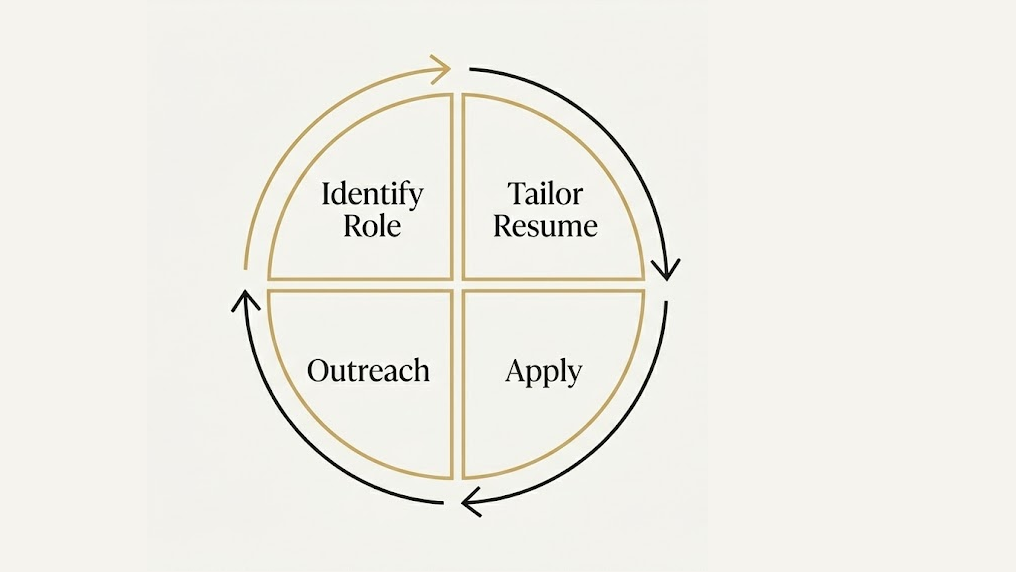
Smart, qualified professionals are sending out 50 applications a week and getting nothing back. The problem isn't effort. It's that each task is being run in isolation, and weakness in any one of them collapses the whole thing. A great resume sent to the wrong roles produces silence. A great target list with a generic resume produces silence. Strong applications with no outreach produces silence. The pieces are interdependent. If you optimize one and ignore the others, you get the same result as if you'd optimized none. That's why I run client searches as a flywheel: four nodes that feed each other, each one strengthening the next.
Node 1: Identify the Role
This is where most searches die before they start. People search by job title. "Project Manager." "Marketing Director." "Senior Procurement Manager." Then they apply to anything that matches. The job title is necessary but not sufficient. Same title means radically different jobs depending on context. A Project Manager in software runs sprints, manages technical scope, and works with engineers. A Project Manager in construction manages site logistics, contractors, and physical risk. A Project Manager at a CPG company runs cross-functional product launches with marketing, supply chain, and retail. Same title. Three different jobs.
The real diagnostic for fit runs across four layers: industry, customer, product or service, and context. The closer you align on those four, the higher your interview conversion rate. The further you stretch, the more your resume has to do work it usually can't do in a 30-second scan. If you're applying broadly across titles and getting nothing, this is almost always why.
Node 2: Tailor the Resume
Once the role is identified, the resume goes to work. Most people get this wrong on the structure level before they ever write a word. I have clients build one master resume - professionally curated, comprehensive, holding everything. The professional summary at the top is written in bullet points, not paragraphs. Two reasons: bullets are easier to tailor, and switching from paragraph format in the summary to bullets in the rest of the resume looks incoherent. Keep the format consistent. Bullets scan better for the recruiter and the ATS.
Tailoring happens only in the summary. The experience section stays fixed. If you find yourself needing to rewrite the experience section to fit the role, one of two things is true: the role is too small a stretch and you're over-engineering the fit, or you need a second resume entirely. I call that second resume a persona. A client of mine is both a project manager and a product developer. Both are true. But you don't tailor a project manager resume to a product developer role. You build two resumes, each anchored in its own identity, and you choose which one to send based on the role. Trying to be both at once dilutes the candidate.
The job search isn't a list of things to get through. It's a system to run.
Node 3: Apply for the Role
This is where the flywheel gets uncomfortable. The honest standard is one hour per application. Research the company. Read recent press, recent product launches, recent leadership changes. Understand who they sell to and what's actually happening in their market. Validate the fit before you click submit. Most people will not do this, which is exactly why doing it works.
The new market is not work harder versus work smarter. It's work smarter and work harder. Both are true. Volume without precision produces silence. Precision without volume produces a search that takes a year. You need both. If you're applying to 30 roles a week at 5 minutes each, you've optimized for the wrong thing.
Node 4: Personalized Outreach
The application is the floor. Outreach is what moves the number. The basic version is a short, concise value-proposition email to the hiring manager or a relevant person at the company, stating why your skills align to the role. That's the template. It will get you better response rates than applying alone.
The version that actually converts is more specific. Reference something from a recent quarterly update. Reference something the person posted on LinkedIn last week. Reference an industry trend that maps directly to a pain point they're likely feeling. The more specific you are, the more it reads like a peer reaching out rather than a candidate begging for attention. Generic outreach gets generic response rates. Specific outreach gets meetings.
Final Thoughts
Each node feeds the next. Better role identification produces a tighter target list. A tighter target list makes tailoring sharper. Sharper tailoring makes the application stronger. A strong application paired with specific outreach is what gets the interview. When the system is running, results compound. When one node is weak, the whole thing stalls and the candidate ends up where most candidates end up: applying harder to the wrong roles with a generic resume and no outreach, wondering why nothing is working.
The job search isn't a list of things to get through. It's a system to run. If you want help running yours, that's most of what I do. Book a call at careerpursuit.net.